
Many Singapore SMEs continue to rely on legacy SAP environments that were originally implemented to support business growth but have since become costly to maintain and increasingly difficult to adapt to changing operational demands. As organisations pursue digital transformation, cloud adoption, and greater business agility, migrating from traditional SAP platforms to modern mid-market ERP solutions has become an effective strategy for reducing operational costs while improving productivity, scalability, and decision-making.
A successful ERP migration extends well beyond transferring data between systems. It requires careful planning, comprehensive process analysis, data cleansing, system integration, user adoption, testing, and governance to ensure minimal disruption to day-to-day operations. Modern ERP platforms provide streamlined business processes, enhanced automation, real-time reporting, mobile accessibility, and improved integration capabilities that empower SMEs to operate more efficiently while positioning themselves for future expansion.
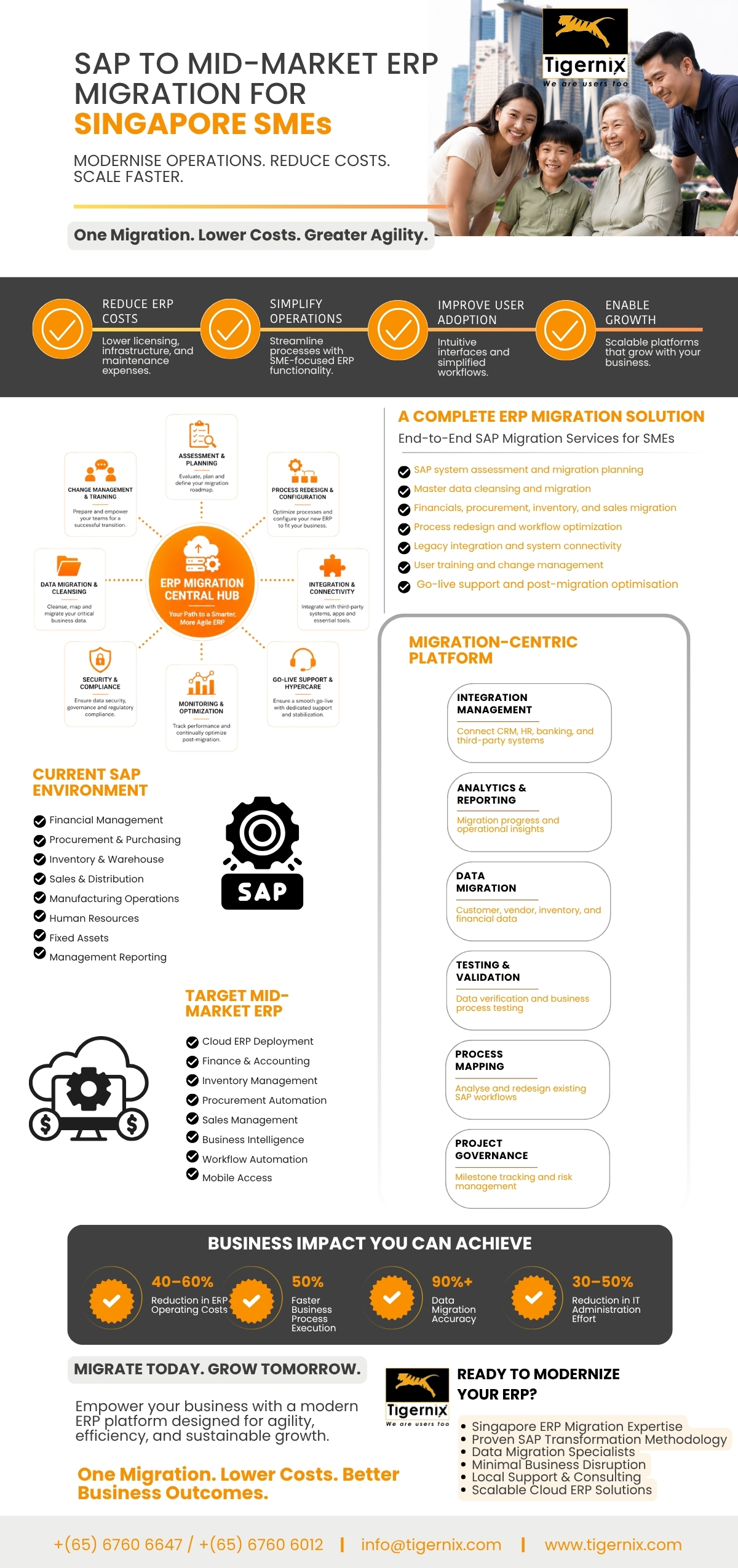
This infographic presents a structured overview of the complete ERP migration journey, highlighting the key stages involved in transitioning from SAP to a modern mid-market ERP platform. It covers migration planning, data management, process redesign, system integration, testing, and post-go-live optimisation, together with the business outcomes organisations can expect from a well-executed transformation. By following a structured migration methodology, Singapore SMEs can modernise their technology landscape, improve operational resilience, and establish a scalable digital foundation that supports sustainable long-term business growth.