

All in the business world know that sales forecasting is no longer just a finance exercise, but the backbone of modern business decision-making. The numbers driving inventory, staffing, and revenue goals all start with sales forecasting, yet most organisations miss the mark by over 10% every quarter.
Sales forecasts are estimates of how many products a company anticipates selling in the future, usually based on information from previous sales trends. Businesses can obtain insights that support operations, planning, and decision-making by using different formulas. To better match their objectives and resources, business owners could find it helpful to calculate the sales prediction for the next month or year.
This article explains what a sales prediction formula is, why it is important, and how to calculate it to expand your revenue.
What is a Formula for Sales Forecast?
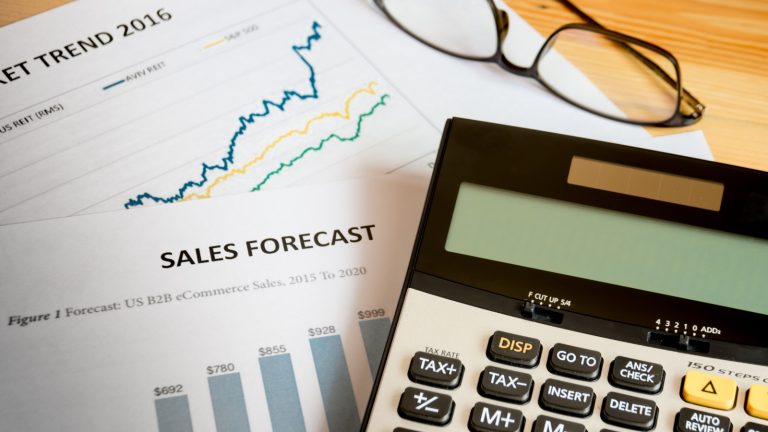
A sales forecast formula is a method commonly used to project future sales for a business, offering insights into possible profitability, customer volumes, transaction rates, and other important variables over a given time frame.
Although there are several ways to calculate sales projections, the majority of strategies include examining past data in conjunction with customer representative comments. Precise sales projections may help businesses better evaluate their financial situation, inform partners of their current state, and make proactive plans to sustain long-term economic viability.
Key Takeaways
- The sales forecast is a mechanism that helps businesses make decisions to boost future revenue through predictions using trends, data volumes, and pipeline insights.
- Clean CRM data, proper segmentation, and selecting the right forecasting method for the business model is the basis for an accurate forecast.
- AI and automation significantly enhance forecast accuracy by delivering real-time, data-driven insights.
Importance of Calculating Sales Forecast
Businesses of all sizes might benefit from calculating sales predictions since it improves their comprehension of operational capacities. Sales forecasting has several advantages, such as:
Making Financial Records
The creation of crucial financial records, including balance sheets, cash flow statements, and profit and loss statements, is based on sales prediction data.
These documents may be essential for evaluating company performance and efficiently interacting with partners or auditors.
Creating a Smart Budget
By precisely anticipating revenue and expenses, business owners can create efficient budgets that support financial stability.
Setting Attainable Objectives
Based on projected sales, business owners can make well-informed choices about employment, marketing, and product offerings. This enables them to make sure the company stays profitable by coordinating their strategies with financial realities.
Effective Inventory Control
By evaluating sales estimates, business owners can predict seasonal inventory demands.
This proactive approach helps them maintain appropriate inventory levels to avoid stockouts or surplus inventory, ultimately leading to cost savings.
Convincing Investors
A strong sales projection can draw investors to startups and new companies by showcasing their potential for expansion and profitability.
This is where a favourable prediction boosts trust in the company’s sustainability and capacity to get capital for operations and growth.
Growth in Business Operations
Sales predictions help business leaders recognise prospects for expansion and make strategic decisions to boost profitability.
For example, if a projection suggests diminishing sales, they can change product features or marketing methods to increase competitiveness and appeal to consumers.
How to Calculate a Sales Forecast
There are several approaches for anticipating sales. Here are some basic procedures to help you calculate a sales prediction for your business:
Monitor the Data of Your Company
To construct a sales estimate, it is vital to track your business’s financial data, notably the monthly sales numbers for each product.
You need to monitor any returns or cancellations as they might be equally crucial. These should be removed from overall sales.
Utilising online software, such as customer relationship management (CRM) systems, can substantially assist in data tracking.
These technologies help in creating sales estimates and also help provide insights into client preferences and behaviours, enabling more informed business decisions.
Choose Your Category and Sales Cycle
Based on your definition of a sales period, choose the sales cycle or time frame you wish to measure, such as a month, quarter, or year. Choose what to forecast next.
To simplify the process, think about classifying your items rather than trying to forecast sales for your complete business or a single product.
If you run a restaurant, for instance, you might project drink sales independently of meal sales. Modify these categories based on the particular insights you want to obtain.
Opt for a Suitable Forecasting Technique
Take your company’s objectives and the complexity of your data into account when selecting a sales forecasting technique.
The following are a few typical categories of sales projection formulas:
- Opportunity Stage Forecasting
In this method, sales prediction is calculated as follows:
Closure rate x total value of current deals in the sales cycle.
This method is ideal for companies with historical data and clear sales pipelines.
- Intuitive Forecasting
This method depends on the knowledge and expertise of salespeople.
It is ideal for new or small-scale companies with little past data.
- Historical Forecasting
Sales x velocity from the previous month equals additional sales; additional sales plus the previous month’s rate equals the anticipated sales for the following month.
It is commonly used for companies having a track record of growth and sales data.
- Multivariable Analysis
This method takes into account a number of variables, including sales cycles, deal probability, sales representative insights, and past data. Usually, sales, forecasting, or CRM software is used to compute it.
It is suitable for companies that require sophisticated forecasting and have intricate sales procedures.
- Bottom-Up Approach
This is where sales prediction is calculated by multiplying the projected number of consumers by the average purchase value.
This formula is best suited for companies that have a solid grasp of their target market and consumer behaviour because it makes assumptions about the number of clients a business can reach.
- New Business Approach
It makes use of sales projections from comparable companies operating in the same sector.
Best option for new companies or companies venturing into untapped markets.
Utilise a Sales Forecasting Formula
Using a year as the time frame, creating an annual sales forecast can be an easy way to project future sales. Compared to more intricate tactics, this method is quick and simple to calculate because it makes the assumption that sales will stay mostly constant.
First, use your existing sales revenue to calculate your average monthly sales. Next, forecast sales for the rest of the year using this average. Just add the sales from the completed months to the projected sales for the following months to get your annual sales prediction. The algorithms for sales forecasts could look like this:
The average monthly sales rate is calculated by dividing the total sales revenue thus far by the number of months.
Potential sales income for the remainder of the year is calculated by multiplying the average monthly sales rate by the number of months remaining in the year.
Annual sales projection is equal to total sales revenue thus far plus potential sales revenue for the remainder of the year.
To estimate your sales for the upcoming year, you can also multiply the total sales from the prior year by the inflation rate. The formula might be as follows:
Annual sales projection = total sales from the previous year plus (total sales from the previous year x inflation rate)
Keep an Eye on Elements That Could Affect Sales
Even though sales projections offer insightful information, it is crucial to take into account outside variables that may affect real sales performance. When estimating sales, it can be helpful to round down and use conservative figures.
To improve its accuracy, you can also update and improve your sales prediction on a regular basis.
As experts believe, improving forecast accuracy requires a combination of strategy and technology. Businesses that use multiple forecasting methods together, such as historical, pipeline, and AI-based models, tend to achieve significantly better results.
Real-time dashboards also play a crucial role by providing up-to-date visibility into sales performance. Instead of waiting for monthly reports, decision-makers can adjust strategies instantly.
AI-driven anomaly detection further improves accuracy by identifying unusual patterns in sales data. This helps businesses react quickly to unexpected changes.
Also, continuous recalibration ensures that forecasts evolve as new data becomes available, making them more reliable over time.
How Tigernix CRM Solution Helps Your Enterprise with Sales Forecasting in the Digital Age
Understanding all the practical challenges your enterprise encounters in the journey of sales forecasting, Tigernix is introducing our robust Customer Relationship Management System that comes with a strong sales forecast sub-module.
Through the powers of AI, Automation, Data Analytics, Data Visualisation, etc. TigernixCRM can help your marketing teams to accurately predict next quarter or year’s sales portfolio.
With our software solution, your enterprise can foresee the demands and well-prepare for the upcoming challenges without wasting your resources or money.
Call us for a personalised demo.
Tigernix-Your Digital Alliance In Business
Achieving Business Growth with the Right Approaches
In this fast-moving business world, it is quite difficult to keep up with the demand and the competition. Businesses that strike the right balance between strategic frameworks and technological support will be the ones who win in the future.
So, why waste time when you can achieve your business goals walking in parallel with the right approaches?
FAQs About Calculating Sales Forecast
A 12-month sales forecast is the framework of estimating future revenue by predicting how much of a product or service will be sold out within the next 12 months. In other words, this is a method to predict how much a product or service is in demand within the next 12 months.
If the overall market size is $40 million, a company can predict it can win 10% of that market within a given period. This makes its sales forecast $4 million for that period. In simple words, it is the portion a company can achieve from the overall value of the market.
The best method to forecast sales always depends on various factors such as data availability, your business model, and market value. Many companies opt for multivariable analysis as it combines pipeline metrics, historical data, and advanced predictive models.
It is a best practice that the leadership layer goes for a monthly roll-up forecast along with weekly reviews at the rep and manager level. However, if the market is highly volatile, then weekly updates are recommended.