A Talent Management System (TMS) might remind you of a background engine that keeps hiring, onboarding, development, and performance all chugging along in the same direction, without everyone living out their days in spreadsheets and splintering email threads. In other words, talent management system software helps you manage the employee lifecycle from onboarding through long-term growth (goal setting, performance reviews, training, and retention).
For a small business, it can be like adding another set of hands to HR. For a fast-growing company, it will demonstrate the difference between organised scaling and chaos.
At its finest, a talent management system is something more than ‘HR software.’ It integrates recruiting software, an applicant tracking system (ATS), employee onboarding workflows, performance management tools, reporting dashboards, and sometimes employee engagement, payroll processing, and benefits administration into one HR platform.
Whether you call it a people management system, a personnel management system, or a workforce management platform, you are seeking clear visibility. Everyone knows what is going on, who owns what, and how progress flows.
We will discove
- What a Talent Management System (TMS) Actually Does
- Core Features of Talent Management System Software
- How a TMS Supports Recruiting and Applicant Tracking (ATS)
- Employee Onboarding That Doesn’t Feel Like Paperwork
- Performance Management: Reviews, Goals, OKRs, and 360-Degree Feedback
- Learning, Employee Training, and Certification Tracking
- Employee Engagement, Retention, and Workforce Planning
- Reporting, HR Analytics, and Compliance Support
- TMS vs HRIS vs All-in-One HR Platform: What’s the Difference?
- How to Choose the Best Talent Management System for Your Business
- Implementation, Setup Time, and Pricing: What to Expect
- FAQs About Talent Management System
What a Talent Management System (TMS) Actually Does

As a central system, the Talent Management System (TMS) houses the most critical ‘people processes,’ so they do not simply live in someone’s head or, worse, get reinvented every time there is a new manager.
Consider it the core that holds your employee lifecycle management together: recruiting, applicant tracking, onboarding, performance reviews, goal setting, development plans, and sometimes compensation reviews and promotions. No more separate worlds of hiring and performance as the TMS connects the dots.
This is exactly what growing businesses need when roles change and teams evolve month to month.
Key Takeaways
- A Talent Management System (TMS) supports the full employee lifecycle: talent acquisition, onboarding, performance management, development, and retention.
- The strongest platforms connect ATS workflows with onboarding software, goal setting, performance reviews, and learning plans.
- Performance management improves when reviews, self-evaluations, peer feedback, and OKRs/KPIs live in one consistent system.
- Reporting dashboards and HR analytics turn guesses into measurable insights for workforce planning and retention strategies.
Gaining Realistic Outcomes?
The most realistic advantage is the predictability. Why do we say that?
A talent management software programme provides your team with a repeatable process for posting job openings, screening candidates, scheduling interviews, sending offer letters with e-signatures, and moving new hires into onboarding workflows. Then it continues to handle employee profiles, competencies, feedback cycles, and performance tracking, all of which reside in one system.
Why should you be concerned about this practicality? That is because people’s work is not a one-and-done thing; it is a domino effect. A great hire still requires a smooth onboarding process, clear expectations, and coaching. Even a top performer still needs growth opportunities, training goals that align with the business, and more.
Less Manual Work, Less Friction
When people look for the ‘best talent management system,’ they are looking for a platform that reduces friction.
Fewer manual handoffs. Less duplicate data entry. Better visibility for managers. Better experiences for employees. And for HR, better reporting dashboards and HR analytics, so decisions are not made on gut feel alone.
Whether you are a one-person HR department at a small business or a global enterprise with hundreds of employees, the best talent management software helps you manage people so it feels less chaotic. It also helps you be less unpredictable and more choreographed, predictable, and measurable.
Core Features of Talent Management System Software
Most of the talent management system vendors develop their products with five key modules in mind: Talent Acquisition (Recruitment), Training and Development, Performance Management, Onboarding, and Reporting. You can read more about building a talent management strategy to understand how these modules fit together.
Employee training and development must be aligned with the skills needed for workforce planning.
Talent Acquisition (Recruitment)
On the recruiting side, a TMS might feature recruiting software and an applicant tracking system (ATS) that allow you to move candidates through the process of tracking them, scheduling interviews with them, candidate ranking, and talking to one another. A number of others even provide social media recruiting, career sites, and job board posting.
Workflow automation is where all of this starts to pay off: automated reminders, shared scorecards, templates for outreach, and structured pipelines that ensure hiring never stagnates.
Onboarding
The smartest systems not only incorporate these modules but also speak to one another. For instance, the position you hired for via the ATS will be added to the onboarding checklist for new hires.
Any goals you agree to during the onboarding process should be reflected in performance reviews.
Performance Management
Performance management is generally the heart of a TMS once employees are on board. You will usually see performance reviews, self-evaluations, manager evaluations, peer feedback, and 360-degree feedback options.
Many also have goal-setting for OKRs and KPIs, along with tools such as 9-box grids to score performance against future potential. On top of that, the leading talent management vendors today commonly include employee engagement features or surveys (or light-weight social feeds). Likewise, companies can also attempt to track mood and recognition.
Training and Development
Employee training and development must be matched to the skills needed for workforce planning.
Reporting and Operational Infrastructure
And then there are the operations that power everything: reporting dashboards, HR analytics, ad hoc reporting (drag and drop a report to be emailed to your team weekly), automated reports (export data for payroll), approvals, and integrations.
These features are less flashy, but this is what makes a people management system dependable. When you can generate a report in minutes, as opposed to days — turnover trends, onboarding completion, performance distribution, training progress — you quit guessing and start leading. Learn more about creating a talent management strategy that puts these insights to work.
How a TMS Supports Recruiting and Applicant Tracking (ATS)
Recruiting is the kind of room that, if there is chaos to be had, chaos will come in.
One open role becomes 10 conversations, six files, three calendar threads, and a few housekeeping notes, such as ‘Did we ever follow up with them?’ moments. That is precisely why an ATS is such a cornerstone of talent gathering.
In a TMS, the ATS acts as the system of record for candidate tracking, including what happened to whom and when in each hiring process step.
The strong recruiting software experience typically begins with job postings. You build a role, post it to your careers portal, distribute it to job boards (with Indeed integration and Glassdoor integration often in the mix), and post it on social media recruiting channels.
Candidates apply, the system screens and organises them, and hiring managers can view profiles, rate applicants, add notes, and share responses without emailing resumes around.
Interview scheduling is also easier, because structured workflows minimise ‘calendar ping-pong,’ which can slow hiring and let good candidates slip away.
More About ATS
What sets a good ATS apart from a great one is architecture without rigidity. You want templates and workflows, but you also ask for flexibility in different positions.
Hiring for a customer support team might include an assessment tool, and hiring for a finance role might require background checks and compliance steps.
A few talent management solutions offer background checks and drug testing workflows, while a firm’s diversity monitoring, EEOC compliance, or affirmative action planning may be important to larger organisations. The objective is not to overcomplicate hiring; it is to ensure that the hiring process matches the role and the risk.
Once you hire them, the ATS should not be a dead end. In a well-structured talent management system, the candidate is turned into a profile of an employee with a history, such as offer letters, role details, start date, manager, and onboarding plan.
That consistency is where a TMS really shines, as it eliminates redundant effort and maintains your team’s cohesion from ‘we should hire’ to ‘they are thriving.’
Employee Onboarding That Doesn't Feel Like Paperwork

Employee onboarding is usually no more than a checklist: forms, log-ins, policies, and you are done.
What is actually happening here, though, is that onboarding is the first true trial of your organisation’s clarity. A TMS equipped with good onboarding software makes that beginning stage something smoother and more humane, such as less ‘here are 14 documents’ and more ‘here is how you will succeed here.’
The most effective onboarding workflows mix purely pragmatic steps (documents and IT setup and benefits enrollment) with cultural and expectations-setters (goals, training plans, introductions, feedback loops).
Workflow automation ensures that onboarding never looks too automated. An employee can be assigned tasks according to logic: paperwork first, sign policies with e-signature, open accounts, meet the team, and start role-specific training. Managers can receive their own checklist, and things like preparing a 30-60-90 day plan, scheduling check-ins, and assigning a buddy.
Plus, HR can monitor who has completed onboarding in real time and guard against the age-old ‘I didn’t get access until week two’ trap that silently undermines morale.
Retention also factors directly into onboarding. Early on, people decide whether the job feels promising or confusing. Organised employee onboarding is an indication of competence and care.
When anything’s messy, it introduces doubt, even when intentions are technically pure. A TMS helps as it stores onboarding tasks, documents, and training in a single place; it creates an employee record that continues to be useful later when used for performance management and employee development.
In more robust platforms, like an all-in-one HR product, onboarding links to payroll processing and benefits administration. This way, employees do not get hung up wondering, ‘When do I get paid?’ or ‘Where do I enroll?’
That is why some growing businesses tend to lean toward a more comprehensive HR platform rather than cobbling together disparate tools. Either way, the objective is the same: onboarding that feels like an embrace, not an obstacle.
Performance Management: Reviews, Goals, OKRs, and 360-Degree Feedback
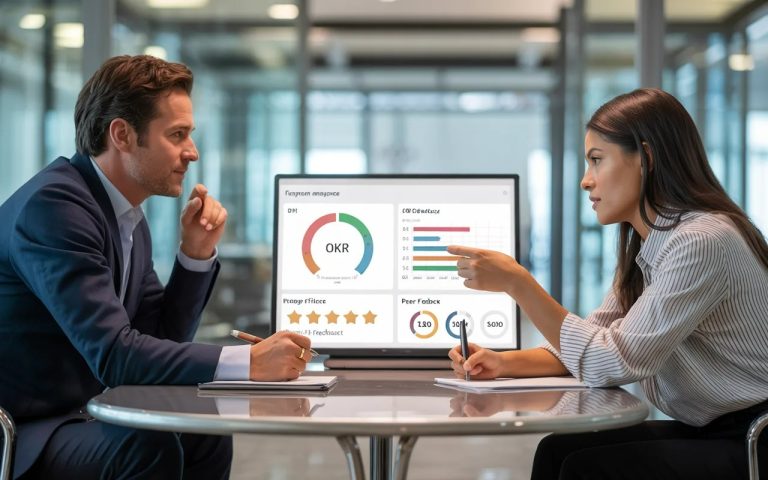
Performance management happens when good intentions either advance or languish in the vagueness of ‘keep it up.’ Performance tracking becomes less awkward and more actionable with a talent management system that helps keep feedback constructive.
Instead of turning to faulty memories during a review, for instance, managers can refer back to the documented goals, notes, and peer feedback as well as self-evaluations in terms that they will have an equitable and specific conversation. That is especially important on fast-moving teams, where work evolves rapidly and contributions are not always visible.
The majority of TMS systems provide performance reviews with configurable cycles, such as quarterly, biannual, annual, or even continuous. On most platforms, you can have one workflow that includes self-evaluations, manager evaluations, and peer feedback, and then add 360-degree feedback when you want a fuller view.
Many of these systems encourage goal setting tied to OKRs and KPIs. That way, it will not be vibe-based; it is results-oriented.
The 9-box grid is still in use for those who prefer a visual framework to compare performance and potential across teams and support succession planning.
A good performance management module should also facilitate coaching. Which is to say, casual check-ins, tracking progress, and flexibility in updating goals without turning everything into an exercise in bureaucracy.
Managers should not have to take a class just to run a review cycle. Workers should not feel blindsided by reviews. The system’s job is to keep expectations clear and conversations frequent enough that nothing blows up at year-end.
Performance management is also related to compensation evaluation and the promotion process, once a company is ready for something more formal. Although not every small business needs a deep compensation engine, the ability to document performance history and growth makes promotion decisions more transparent and fair.
This sense of clarity becomes an advantage in attrition over time, because high performers tend to leave when growth seems random or opaque.
Learning, Employee Training, and Certification Tracking
Training is not just an HR checkbox; it is a leverage point.
When employee training is structured, people ramp up faster; managers are not forced to spend time reiterating instructions; and teams develop skills that align with the direction the business is headed.
Most TM systems offer learning management system (LMS) features or integration capabilities. Great for businesses that have high turnover rates and need to onboard, train on compliance, or customer service (or renew an important technical certification) often.
A great setup for learning within a TMS connects your training to employees’ growth. This means that your training plans are not generic; they are linked to role-based expectations, performance goals, and development paths.
If a particular skill gap appears regularly in performance reviews, for example, the system might assign relevant training, track when it was completed, and how well people are doing. Over time, employee profiles go from just a directory profile to being an ongoing history of knowledge, skills, certifications, and growth.
Certification Tracking
Certification tracking is a big thing in industries where credentials count, such as health care, finance, manufacturing, and even parts of tech. A TMS can keep track of your certification and expiration dates, as well as remind you in advance.
That approach mitigates risk and avoids last-minute scrambles. It also helps managers with tasks like staffing planning, as they can easily see who is qualified to do what.
This kind of visibility makes workforce planning possible and helps teams remain resilient when someone is out or a project ramps up unexpectedly.
On the other hand, learning also impacts retention. People want to stay longer where they perceive they are growing.
The momentum comes from a talent management program that supports development without feeling like homework. It also provides managers with better coaching tools, as they can see progress and use performance conversations to reinforce growth.
In that way, learning is not distinct from performance management. In a good TMS, it is part of the same loop.
Employee Engagement, Retention, and Workforce Planning

Employee engagement may sound like a fluffed-up concept until you start to see what disengagement costs: missed deadlines, slow handoffs, silent churn, and teams that feel as though they are just getting by rather than building.
Most talent management vendors have added employee engagement tools, such as pulse surveys, recognition, and internal social feeds, to their products. The aim is not to turn work into social media, but to provide easy ways for people to communicate valuable information so that wins can be shared or problems can be caught early.
More Focus on Retention
Retention is usually a downstream effect of experiences on a daily basis: clarity of expectations, the quality of your management, opportunities for growth, and whether you see your employees. A TMS helps retention by reinforcing those fundamentals.
It is difficult for people to feel stuck when goals are consistent, performance feedback is fair, and development exists. With an easy onboarding process and accessible training, it makes employees feel like they are given support rather than being thrown into the deep end.
Workforce Planning
Workforce planning is the intersection of engagement and systems with strategy. When you can view skills, performance trends, and hiring pipeline data in one place, planning becomes less reactive.
You can pinpoint roles that are hard to fill, teams at risk of burnout, and skill gaps that training could fix faster than hiring. That is why talent management system software is referred to as a growth tool, not simply HR software. It provides leaders with a better understanding of the talent landscape within the business.
As you can see, small-business HR management can be as simple as engagement features, with straightforward things like regular check-ins, visible goals, and a clean feedback cycle. In larger teams, engagement tools may include things like surveys and analytics or structured programmes.
Regardless, the solution is rhythm: a cadence of communication and progress that ensures all teams are in sync, even as they move at company speed.
Reporting, HR Analytics, and Compliance Support
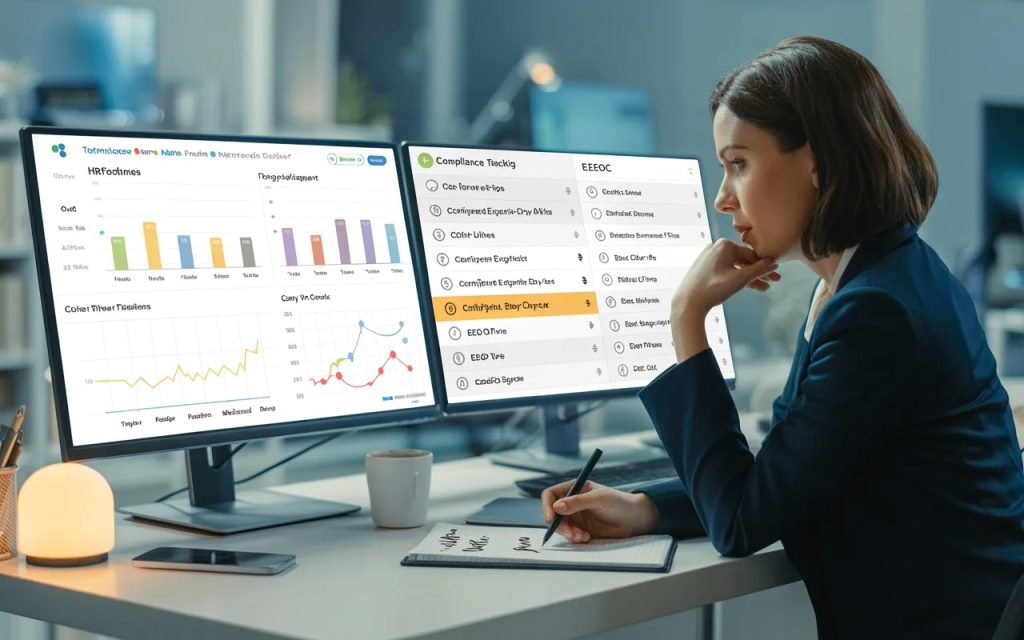
The TMS reporting dashboard is where a TMS quietly beacons you to its subtle kingship. It is the difference between: ‘I think turnover is increasing’ vs. ‘Turnover is up 12% in this department over the last two quarters, and the exit feedback points to workload and manager support.’
HR analytics let you monitor how quickly positions are filled, onboarding time and effectiveness, performance distributions, training progress, and employee lifecycle trends, which you can use to make better decisions.
Since HR questions hardly ever come in nice, predictable packages, a robust system provides some measure of ad hoc reporting as well as automated reports to answer those queries. Quickly, leaders ask for the people count, open roles, time-to-hire, performance results, and training compliance.
It saves you time and minimises errors by letting you create answers without manual spreadsheets. And when data remains stable, trust increases, as reports are sourced from a single version of the truth.
Compliance Support
Compliance support is somewhat industry- and region-specific, but many organisations can take advantage of secure document storage, audit trails, standardised processes, and, for some, EEOC compliance tools.
Some configurations include diversity tracking and affirmative action analysis capabilities. Even if an organisation does not need advanced compliance modules, the most basic tracking (who attended training or signed the policy, and who has an expiring certification) is a way to mitigate risk and avoid surprise attacks.
Reporting also supports culture. When well-managed goals, performance feedback, and development are systematically recorded, conversations become more fact-based and less political.
That does not reduce people to numbers; it makes choices that can be explained clearly. In healthy organisations, transparency is not only valued. It is also integrated into the systems people use every day.
TMS vs HRIS vs All-in-One HR Platform: What's the Difference?
TMS is generally all about the talent aspect of the employee lifecycle, including recruiting, onboarding, performance management, and learning and development. An HRIS (Human Resource Information System) typically focuses on core HR data such as employee records, time off, organisational structure, and sometimes payroll fundamentals.
An all-in-one HR solution aims to combine these, providing a more holistic HR platform that includes talent management, payroll processing, and benefits administration.
In the real world, the ‘right’ choice depends on what use case you are solving. If your pain is with hiring and performance, perhaps the need is a top-tier ATS and talent management system with a powerful performance module.
If your pain is administrative, benefits enrollment, managing payroll provider needs, and maintaining employee records, an all-in-one HR platform might be a better fit. Several companies begin with discrete tools and combine them as complexity increases.
Integrations are as important as features. A smaller company, however, may use one system (TMS) to recruit and perform, but payroll lives elsewhere. And if those tools integrate nicely, then you can get 90% of the benefits without mandating a full suite.
Others like just having one vendor because it minimises hand-offs and makes support easier. That is why you will see more comparisons between established platforms and talent management vendors.
In other words, a TMS is typically the ‘growth engine’ that drives people development and performance. An HRIS is the ‘record’ system. An integrated HR solution claims to be both. The best fit is the one that matches your current stage and removes the most friction right now.
How to Choose the Best Talent Management System for Your Business
Finding the right talent management software isn’t about selecting the one with the most features. It is more about creating a system people will actually use.
When the interface is heavy or workflows are confusing, adoption plummets, and the system becomes an expensive filing cabinet. Managers should find the right TMS just about as natural and intuitive as possible, employees should experience it as clean and simple as possible, and HR needs to live with it on a daily basis.
That means you need the basics to be solid: applicant tracking, onboarding, performance reviews with feedback, goal setting, and reporting.
First, map your actual workflows. How do you hire today? Where does it stall? What is broken in onboarding? How do you maintain performance conversations? Is it a rhythm or all over the place? The most effective talent management tools are the ones that reflect your rhythm and nudge it, making sure it improves, not force-fits your team into a template.
If your business is small, you might be more in favour of simple and quick. If you are a scale-up, you might care more about customisation and the depth of reporting and integrations.
Also, consider what you will need next, not only today. What a fast-growing company may eventually need is additional employee training, learning management system support, certification tracking, or structuring employees’ life stage development.
A different organisation might require more effective employee engagement tools or greater visibility in workforce planning. Think of the system as a base, something that should still make sense when you add 20 or 200 people.
Last but not least, support and implementation should not be underestimated. How well you are able to get up and running, how much training you need, and the customer service experience can make or break it.
The finest platform dissolves into nothing if you cannot get help when it is needed. Ask how onboarding is handled, what training resources are provided, and whether reporting dashboards and workflows can be customised without requiring costly custom work.
Implementation, Setup Time, and Pricing: What to Expect
To implement, you need to bring binary expectations face-to-face with reality. This type of software often has tentacles that reach into many different teams in an organisation, HR and otherwise. So it tends to take a short while to set up: anywhere from ‘done in a week’ to ‘a several-month-long process’ being typical. Learn more about talent management implementation considerations.
The timeline is contingent on the number of modules you are using (ATS, onboarding, performance management, learning and development, payroll processing, benefits administration), how many integrations you require, and the quality of your existing data.
For most small businesses, it makes sense to start on the basis of core talent management: recruitment software + ATS, onboarding software, and performance management. That delivers immediate value and does not crush the organisation.
The team can easily take on employee engagement tools, HR analytics, and deeper reporting once they have the basics under control. For larger companies or ones transitioning from various systems, implementation might be more planning-intensive, including mapping workflows, managing permissions, setting review cycles, and managers’ coaching.
Pricing varies widely. Some vendors charge per employee per month. Some work with annual contracts, and may even charge to get you set up. It is worthwhile to ask what it includes: performance reviews, goal setting, reporting dashboards, integrations, and support.
You will also want to ask whether ‘advanced’ analytics or LMS features cost more and whether automated reporting adds another line item to your bill. It is not so much the subscription that will cost you as it is all the time and effort your team spends banging its head against the system, actually working.
These systems might have their pluses and minuses, but those that save hours each week will be more cost-effective than those that are slightly cheaper but create friction.
That is why you need to use the platform that fits your operational maturity. If your workflows are still in flux, focus first on flexibility and simplicity. If your systems are in place, focus on depth, analytics, and reliability.
Either way, the motivation is the same: less busywork, more clarity, better decisions.
From Hiring to Growth: The True Power of a TMS
A Talent Management System is ultimately about making people operations feel coherent. Instead of treating hiring, onboarding, performance reviews, and employee training as disconnected tasks, a TMS connects them into a practical flow that supports growth.
It helps you recruit smarter with an ATS, onboard faster with repeatable workflows, manage performance with goals and feedback, and build skills through learning and development tools, all while giving you reporting dashboards and HR analytics to guide decisions.
Whether you are a small business building a structure for the first time or a growing organisation trying to scale without losing control, the right talent management software creates momentum. It reduces the daily friction that drains time and energy, and it replaces guesswork with visibility.
In the long run, that is what makes a TMS valuable: not just managing people, but helping them thrive in a system that makes sense.
FAQs About Maintenance in Business
A Talent Management System (TMS) is a software platform designed to manage the full employee lifecycle, including talent acquisition, onboarding, performance management, training and development, and reporting. It often integrates recruiting software, an applicant tracking system (ATS), goal-setting tools, employee engagement features, and HR analytics into a single, connected system that supports workforce planning and organisational growth.
An applicant tracking system (ATS) focuses primarily on recruitment functions, including job postings, candidate tracking, interview scheduling, and hiring workflows. A Talent Management System (TMS), by contrast, extends beyond hiring to include onboarding, performance reviews, employee development, learning management, reporting dashboards, and engagement tools, creating a more comprehensive people management solution.
Core features typically include Talent Acquisition (Recruitment), Onboarding, Performance Management, Training and Development, and Reporting. Many systems also offer goal-setting frameworks such as OKRs and KPIs, 360-degree feedback, employee engagement surveys, workflow automation, HR analytics, and automated reporting tools that support payroll processing and workforce planning.
Yes. A Talent Management System can be highly beneficial for small businesses, particularly those experiencing growth. By centralising recruiting, onboarding, performance tracking, and reporting, a TMS reduces administrative burden, improves consistency, and supports employee retention. Many vendors offer scalable pricing models that allow smaller organisations to adopt essential modules without unnecessary complexity.
A TMS improves performance and retention by providing structured performance reviews, self-evaluations, manager evaluations, peer feedback, and goal alignment through OKRs or KPIs. It also supports employee development through training modules and certification tracking. When employees receive clear expectations, ongoing feedback, and development opportunities, engagement increases, and turnover typically decreases.