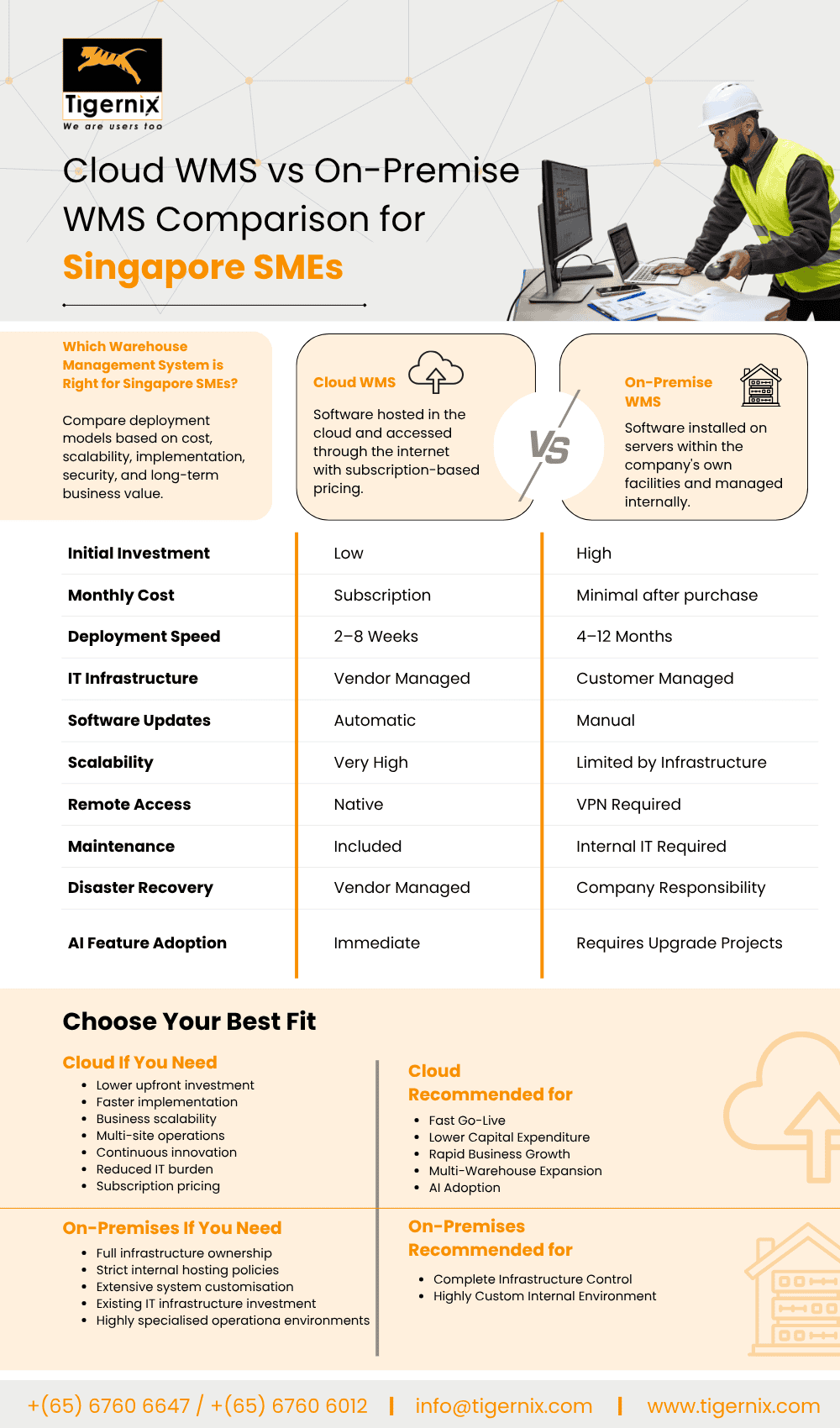

Let’s say you evaluated operational needs, scenario-based testing environments, budget restraints, and WMS flexibility before subscribing to a Warehouse Management System. But what if you were wrong about the deployment model? Before answering this question, it is important to know there is no “correct deployment” for a WMS; cloud, web-based, or on-premise deployment may be the right choice in different situations. That is why you need to choose a deployment model that fits your warehouse and company culture, without creating unnecessary IT complexity later.
Cloud deployment and on-premise deployment each have pros and cons; understanding the management implications, costs, deployment challenges, risks, and advantages of both is the first step before comparing them against your organisation’s unique WMS adoption requirements.
Read the following infographic to understand the uniqueness of a cloud WMS and an on-premise WMS and how WMS deployment in Singapore can vary from one manufacturing facility to another. This graphic outlines the challenges of deploying WMS for SMEs in Singapore and how they should assess their IT infrastructure, automation requirements, and digital transformation goals before adopting a WMS.